
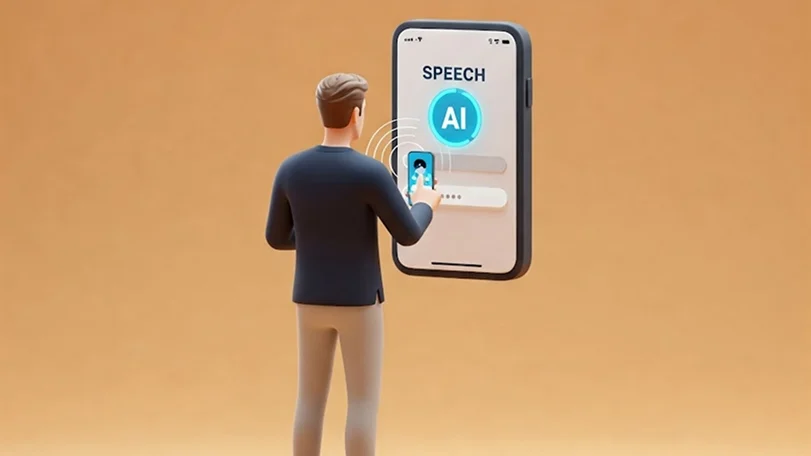
The area of artificial intelligence that allows robots to comprehend, interpret, produce, and react to human speech is known as voice AI technology. It bridges the gap between human communication and machine reaction, making it one of the most revolutionary areas in AI. Speech technology has advanced over time from simple voice recognition software to extremely sophisticated systems that can identify emotional tones, adapt to accents, have real-time conversations, and even comprehend context. Speech AI is influencing how people engage with the digital world more and more, from accessibility features, transcription tools, and customer support bots to personal assistants like Siri and Alexa.
Natural language processing (NLP) and automated voice recognition (ASR) are the two fundamental skills of speech artificial intelligence. Spoken language is transformed into written text via ASR. ASR is the underlying technology that records and converts your voice into legible text when you speak into your phone or dictate a message. In contrast, NLP analyzes this language and deciphers its meaning, enabling robots to comprehend the content and choose the proper response. When combined, these techniques enable smooth communication between users and gadgets, humanizing and democratizing technology.
Large volumes of audio data are used to train different machine learning models and neural networks in order for voice AI to work well. These models pick up speech patterns including timing, pitch, tone, and pronunciation. The AI can now manage a variety of languages, dialects, speech rates, and even background noise thanks to this training. Today’s voice assistants, for instance, can detect commands over background noise or differentiate between several speakers in the same space. The AI becomes better at accurately identifying and reacting to human speech the more data it is trained on.
Virtual assistants are one of the most well-known applications of speech AI. Speech recognition is used by assistant-powered devices such as Google Assistant, Amazon Alexa, Apple Siri, and Microsoft Cortana to enable hands-free operation. Reminders, internet searches, music playback, smart home device control, and even voice-activated phone conversations are all available to users. Particularly for elderly users, those who prefer voice over typing, and those with physical disabilities, these assistants mark a significant advancement in accessibility and convenience.
Beyond consumer electronics, speech AI is essential in professional and business contexts. AI-powered voice bots are increasingly being used in customer service to handle first-contact customer interactions, respond to commonly asked questions, process payments, and direct calls to the appropriate departments. These systems can scale across regions, run around the clock, and cut down on wait times, all of which improve customer service effectiveness. AI-powered speech analytics in contact centers may assess a customer’s voice for stress, tone, and attitude to help human agents reply appropriately.
Another area where speech AI is making great progress is transcription services. Speech AI is used by programs like Otter.ai, Google Recorder, and Microsoft Teams’ live transcription to instantly transcribe podcasts, lectures, meetings, and interviews. This is helpful not only for maintaining records but also for making content accessible and searchable, particularly for people who require language support or are hearing challenged. These tools are quite useful in collaborative settings because many of them can recognize many speakers and assign text appropriately.
Speech AI in education facilitates accessibility, pronunciation coaching, and language acquisition. Applications for teaching English or other languages, for instance, employ speech recognition to assess a student’s pronunciation and provide immediate feedback. Tools that translate text to speech or speech to text help students with learning disabilities engage more fully in class activities. In contemporary learning settings, when a variety of demands must be met by technology, this kind of inclusiveness is essential.
Speech AI is being used in healthcare as well. Notes are now automatically transcribed and entered into electronic health records by doctors who dictate them. This lowers the possibility of data entry errors, cuts down on paperwork, and frees up doctors to concentrate more on their patients. Some hospitals communicate with patients via voice systems driven by AI to remind them of appointments, assess their symptoms, or provide instructions for post-operative care. Speech technology will play a bigger part in telemedicine and remote consultations as it advances, allowing for real-time documentation and language translation.
The ability of voice AI to recognize emotional tone is an intriguing development. In order to determine whether a speaker is furious, joyful, nervous, or puzzled, this entails examining voice cues such pitch, tempo, pauses, and intensity. This is especially crucial in customer service or mental health apps where results may be impacted by emotional sensitivity. AI can customize its responses, reduce annoyance, or provide sympathetic communication by recognizing the user’s emotional state.
Another field that is becoming more popular is voice biometrics. Some systems now employ speech recognition to identify users instead of fingerprint sensors or passwords. Like fingerprints, each person’s voice has distinct characteristics. Secure access systems, banking, and other settings where identity verification is essential can all benefit from voice authentication. It provides an extra degree of security and convenience, but like all biometric systems, it needs to be made resistant to imitation or spoofing.
Although voice AI has many advantages, there are also significant drawbacks. At the top of the list is privacy. Devices that are always listening for voice commands need to be built with user data protection in mind, making ensuring that conversations aren’t recorded or utilized improperly without permission. These issues are intended to be addressed by regulatory frameworks such as the GDPR in Europe and several privacy laws across the globe. Developers must create systems that are transparent and make it obvious what information is gathered and how it will be used.
Another problem is bias. The quality of AI models depends on the quality of the data they are trained on. A model may have trouble understanding speakers of other dialects, regional accents, or speech patterns if it has been trained mostly on English spoken with a particular accent. This may result in mistakes or exclusion. Businesses need to make investments in training datasets that are more inclusive and fully reflect the diversity of speakers around the world.
Another crucial performance indicator is latency, or how long it takes a system to react to a voice command. Efficient software, well-optimized hardware, and occasionally robust cloud computing are necessary for faster processing. Privacy-conscious customers frequently favor on-device processing, which lowers data transmission and speeds up reaction times, even though many gadgets process data on distant servers. By enabling sophisticated AI functions directly on user devices, edge computing advancements seek to close this gap.
Speech’s future The direction of AI is toward increasingly more organic, human-like communication. AI systems that can hold conversations, comprehend context over several dialogue rounds, and modify their responses based on human behavior are being developed by combining technologies like massive language models with speech production tools. These systems are capable of anticipating needs, making recommendations, and learning from previous interactions in addition to being able to respond to reactive commands.
Additionally, multilingual capabilities are developing quickly. Real-time speech translation between languages is now supported by certain AI solutions, removing barriers to communication and facilitating international cooperation. Global education, humanitarian efforts, tourism, and worldwide commerce can all benefit from this. It is anticipated that as the underlying models advance, translation quality and cultural subtlety identification will also improve, resulting in more accurate and seamless communication.
Speech AI is being utilized in media and entertainment to produce audiobooks, develop artificial voices for characters, and even, with permission, mimic the voices of celebrities. Voices from a few minutes of audio can now be cloned thanks to deep learning. Although this technology requires ethical application, it creates new creative opportunities for immersive media, video games, and movies.
Speech AI will become increasingly integrated with other AI fields, such as computer vision, robotics, and augmented reality, as it develops further. Imagine wearing smart glasses that can not only see the outside world but also hear and understand your voice. They could use verbal cues to guide you through tasks or translate languages in real time. Voice-activated navigation, entertainment, and even climate management are already possible in smart cars thanks to speech AI. Emotional feedback systems that adjust to driver stress or weariness may be a feature of future automobiles.
To sum up, voice AI technology is transforming how humans communicate with one another, robots, and content. It moves the goal of seamless, organic human-technology communication closer to reality. Speech AI is opening up new possibilities for accessibility, productivity, and personalization in a variety of fields, including personal assistants, healthcare, education, business, and entertainment. To guarantee that its advantages be distributed widely and fairly as technology develops, it will be crucial to appropriately handle concerns like privacy, bias, and data security.